
What Is the Right Price for Donated Goods?
Many people within charities assume that charity shops should simply increase prices in line with inflation to boost sales. It sounds logical—but in reality, pricing in charity retail is far more nuanced. Unlike traditional retail, where pricing is driven by profit margins and predictable supply chains, charity retail relies on donated stock and highly varied local markets. That’s where ‘Sweet Spot Pricing’ comes in.
Why consider increasing prices?
Costs are rising across all sectors, but for charities the impact is especially significant. Higher operating costs can directly reduce the services they provide, making effective pricing even more critical.
While Traditional retailers often raise prices to offset increased costs, this approach doesn’t translate neatly to charity shops. However, what is often misunderstood a blanket price increase may backfire in charity retail, although all retailers face cost pressures, charity shoppers often react negatively to sudden price rises, even when traditional retailers see little pushback.
Because charity shops typically work from a 100% margin on donated items, the challenge isn’t covering supplier costs—it’s identifying the optimal price (often called sweet spot pricing) that maximises total revenue.
What Is Sweet Spot Pricing?
Sweet Spot Pricing is the science of finding the balance between:
- Pricing too high can reduce sales volume and reduce total income
- Pricing too low, which can increase sales volume but reduce total income
The “sweet spot” is where the price and volume together generate the highest possible sales for that specific shop.
Crucially, the sweet spot isn’t universal. It varies by:
- Local demographics
- Shop format
- Competitors in the area
- Quality and quantity of donations
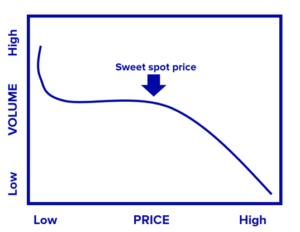
When executed well, Sweet Spot Pricing can increase revenue by up to 10%, significantly boosting the funds available for charitable work.
Five Ways to Achieve Sweet Spot Pricing
- Understand your local context.
Study the area’s demographics, the shop format, and the competitive landscape. - Know your donations.
The types and quality of donated items directly influence how you price. - Train your team.
Equip staff with the skills to price donations accurately using consistent frameworks such as the four brand pillars for clothing and accessories. - Use a comprehensive brand directory.
Reliable tools—such as the Skyline Brand Directory with over 2,100 brands—help teams identify labels quickly and price confidently. - Create tailored price guides for each shop.
Bespoke guides (Skyline can produce these) grounded in local data, ensure pricing reflects the unique profile of each community and donation mix.